
November 11, 2026
Virginia pines can be more vulnerable to uprooting or structural failure than some trees found on Mechanicsville properties. Contributing factors include their relatively shallow roots, susceptibility to windthrow, damage from ice or snow, and root stress in saturated or poorly aerated soil. Removing nearby trees can also expose a pine to wind it didn’t previously receive.
That doesn’t mean every Virginia pine is dangerous or destined to fall. Risk depends on the individual tree, its age, roots, condition, exposure, growing site, recent weather, and what could be struck if it failed. A healthy-looking pine in a protected location may remain stable, while another tree with damaged roots or a new lean may need prompt evaluation.
Virginia Pine Characteristics Linked to Failure
Virginia pine, or Pinus virginiana, is a native, small- to medium-sized evergreen found throughout Maryland and much of the eastern United States. Its natural growth pattern helps explain why some mature specimens become vulnerable when their surroundings change.
The USDA Forest Service description of Virginia pine identifies it as a shallow-rooted species. The same source notes that windthrow losses can occur when older stands are thinned too heavily. It also documents the species’ susceptibility to windthrow and damage from ice and snow.
Shallow roots aren’t automatically defective. Roots commonly spread outward through the upper layers of soil where oxygen, moisture, and nutrients are available. A Virginia pine with healthy roots, suitable soil, and adequate growing space may remain stable for years.
Problems arise when the root system loses strength or can no longer resist the forces acting on the crown and trunk. Root cutting, decay, waterlogged soil, erosion, construction, and changes in wind exposure can reduce that support.
Age and Natural Growth Form
Virginia pines are relatively short-lived compared with many long-lived hardwoods. The USDA’s Fire Effects Information System species review reports that senescence commonly occurs around 65 to 90 years, although some trees live longer. The species usually develops a relatively short trunk, irregularly spaced branches, and a sparse or flat-topped crown as it matures.
Age alone doesn’t determine whether a pine should be removed. It does make changes in crown density, trunk condition, root health, and site exposure more relevant. Older Virginia pines may also develop heart rot or other decay that weakens wood without creating an obvious problem from a distance.
Ice and wet snow add weight to branches. Wind places lateral force on the trunk and root system. If the roots or lower trunk are already compromised, that added load can expose a weakness that had not previously produced visible movement.
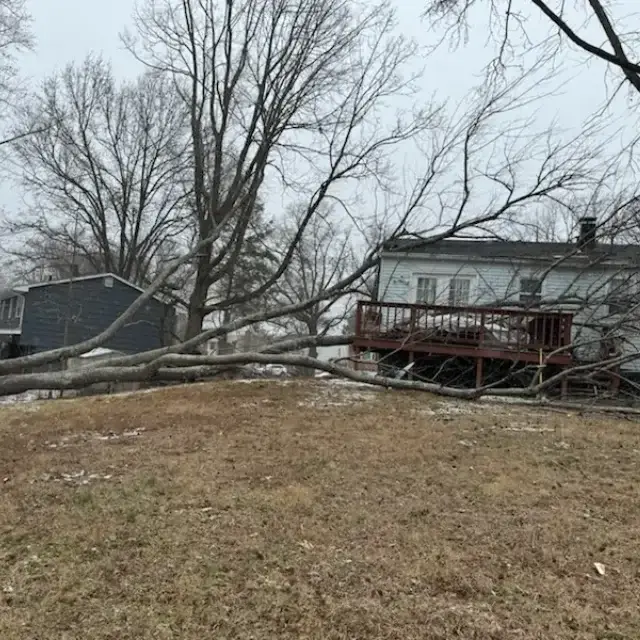
Mechanicsville Property Conditions Can Increase Risk
Conditions around a home can matter as much as the species itself. A Virginia pine growing in suitable, well-drained soil may respond differently from one beside a compacted driveway, recently excavated yard, drainage outlet, or low area that stays wet after heavy rain.
Our Mechanicsville tree-service page covers the broader tree-care needs of local properties. For Virginia pines, the most relevant conditions are those affecting the root zone and the amount of wind reaching the crown.
Saturated Soil and Poor Root Aeration
Virginia pine performs best in moderately well-drained to well-drained soil. The USDA notes that the species is less tolerant of wet sites and impeded drainage than pitch pine and loblolly pine.
The University of Maryland Extension’s guidance on excess water explains that too much soil moisture can reduce oxygen, damage fine root hairs, and prevent a root system from absorbing water normally. Symptoms may not appear until after damage has already occurred.
Wet ground can create two separate concerns. First, soil may provide less resistance to root movement during strong wind. Second, prolonged poor drainage can weaken or kill roots, reducing the tree’s anchorage over time.
This is why a pine may begin leaning after a long period of rain even if the trunk remains intact. The wind may move the trunk and root plate together as the surrounding soil shifts.
Root Decay, Compaction, and Construction Damage
Root problems can develop when soil drainage changes, heavy vehicles compact the ground, or excavation cuts through structural roots. Adding or removing soil around a tree can also affect root function by changing access to oxygen and water.
The University of Maryland Extension’s root-rot guide notes that fungal root diseases can reduce and decay a tree’s root system. It also explains that root decay may contribute to leaning and windthrow after heavy storms. Warning signs can include mushrooms or shelf-like fungal growth, resin near the base of a pine, discolored wood, smaller needles, crown thinning, and dieback.
Homeowners should pay attention to recent work near a pine. Utility trenching, driveway installation, grading, drainage changes, and foundation projects may affect roots even when the trunk was never touched.
Greater Exposure After Nearby Trees Are Removed
Trees growing together affect how wind moves through a property. A Virginia pine inside a stand may have developed while neighboring trees reduced its direct exposure. Removing those neighbors can leave the remaining pine taking the full force of winds that were once filtered by the group.
This change doesn’t mean the remaining tree will fail. It does justify a closer look, especially if the pine is older, tall relative to its surroundings, already leaning, or growing in disturbed soil.
If several trees are being removed or cleared, it’s worth considering the remaining trees before work begins. Our Southern Maryland service-area information provides the communities where our team handles tree-related property concerns.
Uprooting, Trunk Failure, and Branch Failure Are Different Problems
A homeowner may say that a tree “fell,” but several types of structural failure can produce that result. The difference matters because each failure mode has different warning signs and possible responses.
- Whole-tree uprooting: The root plate lifts or rotates, soil cracks around the base, and the tree falls with much of its root system attached.
- Trunk failure: The trunk breaks at a weak, cracked, decayed, or damaged point while some or all of the root system remains in place.
- Branch or top failure: A large limb or upper section breaks without the entire tree falling.
- Progressive leaning: A tree that already leaned begins shifting farther because its roots or surrounding soil can no longer hold it in the same position.
A Virginia pine with shallow roots may be discussed mainly as an uprooting concern, but that isn’t its only possible failure mode. Decay, storm damage, competing stems, branch attachments, and prior wounds can affect the trunk and crown as well.
The consequence of failure also matters. A tree deep in a wooded area presents a different level of concern from a pine that can reach a house, driveway, play area, road, or neighboring property. Tree risk includes both the chance of failure and the potential target.
Warning Signs Around a Virginia Pine
Some changes deserve evaluation even when the tree is still standing and covered with green needles. A single symptom doesn’t always establish that the tree is unsafe, but new movement or several symptoms appearing together shouldn’t be ignored.
Look for:
- A new lean or an existing lean that appears to be increasing
- Fresh cracks or raised soil around the base
- A root plate beginning to lift on one side
- Exposed, cut, crushed, or decayed roots
- Mushrooms, conks, or unusual fungal growth near the trunk
- Resin flow or soft, discolored wood near the base
- A split, cavity, or open crack in the trunk
- A crown that is thinning or losing its normal needle color
- Shorter-than-normal new growth
- Broken, hanging, or partially attached limbs
- A dead top or extensive dieback
- Recent excavation, grading, trenching, or heavy-equipment traffic near the tree
- Increased wind exposure after neighboring trees were removed
Compare current conditions with older photos if they’re available. Changes in the trunk’s angle, the ground around the base, or the shape of the crown may be easier to recognize when viewed over time.
Don’t climb a questionable pine or strike, drill, or cut into it to look for internal decay. A tree under tension can shift without warning, and testing it without the right training can make the situation more dangerous.
Green Needles Don’t Confirm Structural Stability
A Virginia pine can retain green needles while having root damage or hidden decay. Foliage provides information about the tree’s biological condition, but it doesn’t offer a complete picture of structural support.
Roots may be cut on one side while enough of the remaining system continues supplying the crown. Decay can also progress below ground or inside the lower trunk before widespread needle discoloration becomes visible. After extended wet conditions, symptoms may appear well after the roots were first damaged.
The reverse is also true. A pine with some discolored needles isn’t automatically about to fall. Needle changes can have several causes, including seasonal shedding, root stress, insects, disease, or environmental conditions.
A useful assessment considers the whole tree and its surroundings:
- The condition of the visible roots and root flare
- Recent changes in lean or soil position
- Trunk cracks, cavities, decay, and old wounds
- Branch condition and crown density
- Drainage, compaction, and construction activity
- Recent exposure changes
- Distance from homes, vehicles, roads, and gathering areas
No visual assessment can guarantee that a tree will never fail. Its purpose is to identify observable defects, consider likely failure modes, and determine what action is reasonable for the setting.
Pruning, Monitoring, and Removal Decisions
Pruning can address certain crown and branch concerns, but it cannot repair lost structural roots, reverse extensive root decay, or stabilize a root plate that has started moving. Removing branches also doesn’t guarantee that the whole tree will withstand future storms.
Appropriate tree trimming and pruning may remove dead, broken, or poorly attached limbs. It may also reduce a specific branch-related concern when the rest of the tree is suitable for retention. Topping isn’t an appropriate solution because it leaves large wounds, removes excessive foliage, and can lead to weakly attached new growth.
Monitoring may be reasonable when a tree has no urgent defect and changes can be documented over time. Photos taken from the same safe location can help track lean, crown condition, or changes in the ground around the base.
Removal isn’t the default recommendation for every Virginia pine. It may become the practical option when severe root loss, advanced decay, major structural damage, or continuing movement makes the tree unsuitable to retain near a target. Our tree-removal service information explains the service without replacing an evaluation of the individual tree.
The decision should account for the tree’s condition, likelihood of failure, likely failure direction, and what could be hit. A tall pine beside an occupied home calls for a different response than a comparable tree with open space around it.
Steps Before and After Severe Weather
A brief check from a safe location can help homeowners identify meaningful changes before and after a storm. The goal isn’t to perform a technical inspection. It’s to notice visible movement or damage and keep people away from a potential hazard.
Before Severe Weather
- Look at the tree from the ground and note any existing lean, hanging branch, or damaged top.
- Move vehicles and portable belongings away if a known concern can reach them.
- Keep children and pets out of areas beneath damaged branches.
- Don’t attempt last-minute climbing, cutting, cabling, or branch removal.
- Photograph visible conditions from a safe distance if doing so doesn’t place you under the tree.
After Severe Weather
- Check for a new lean, lifted roots, cracked soil, broken limbs, or trunk damage.
- Keep people and vehicles away from a tree that has moved.
- Don’t walk under hanging branches or a suspended top.
- Stay away from any tree or branch touching a utility line.
- Contact emergency services or the utility company if power lines or an immediate public danger are involved.
- Arrange a professional evaluation when new movement or significant damage is visible.
Our storm-damage cleanup service covers fallen trees, branches, and debris after severe weather. A standing tree that is actively shifting, hanging over an occupied area, or creating an immediate hazard may require emergency tree-removal assistance.
Help With a Virginia Pine in Mechanicsville
Virginia pines have characteristics that can make them vulnerable under certain conditions, but species alone doesn’t decide the outcome. The tree’s roots, soil, age, structure, exposure, recent weather, and surroundings all need to be considered together.
If a Virginia pine on your Mechanicsville property has developed a new lean, lifted soil, visible root damage, a trunk crack, storm damage, or another concerning change, contact Empire Tree Services. Our team can review the condition and discuss the next practical step without assuming that removal is the only option.