
September 8, 2026
Key Takeaways
- Drought stress often shows up gradually, through wilting, leaf scorch, and early leaf drop, rather than sudden tree failure.
- Southern Maryland’s clay-heavy soils and humid summers can mask early drought symptoms, making trees look fine on the surface while roots struggle underneath.
- Newly planted and young trees are considerably more vulnerable to drought than mature, established ones.
- Deep, infrequent watering is more effective for tree health than frequent shallow watering.
- Drought-stressed trees are also more vulnerable to pests, disease, and storm damage, so addressing stress early helps prevent bigger problems down the line.
Southern Maryland’s climate is generally humid, but that doesn’t mean local trees are immune to drought stress. Extended dry stretches during the summer months, combined with the region’s clay-dominant soils, can leave trees short on water even when it doesn’t feel like a “drought” in the traditional sense. Recognizing the early signs of drought stress gives homeowners in Mechanicsville, Leonardtown, Prince Frederick, La Plata and across St. Mary’s, Charles, and Calvert Counties a chance to intervene before a struggling tree becomes a dead one.
Why Southern Maryland Trees Are Vulnerable to Drought Stress
It might seem counterintuitive in a region known for humidity and regular rainfall, but a few local factors make drought stress a real concern here:
- Clay-heavy soils common throughout Southern Maryland drain slowly and can crust over during dry spells, which reduces water penetration to the root zone even when rain does fall.
- Compacted soil around driveways, patios, and heavily used yard areas restricts root expansion and water absorption.
- Shallow root systems on younger or recently transplanted trees haven’t developed the deep root structure needed to access groundwater during dry stretches.
- Heat and humidity together increase a tree’s water loss through its leaves (transpiration), which can outpace what the roots are able to take up during a dry period.
A stretch of two to three weeks with minimal rainfall during peak summer heat is often enough to trigger visible stress symptoms in vulnerable trees.
Common Signs of Drought Stress
Drought symptoms tend to progress in stages. Catching them early gives a tree the best chance of recovery.
1. Early signs
- Leaves that wilt during the heat of the day but appear to recover somewhat overnight
- Leaves curling or folding inward, particularly on broadleaf trees
- Slight dulling of leaf color
2. Moderate signs
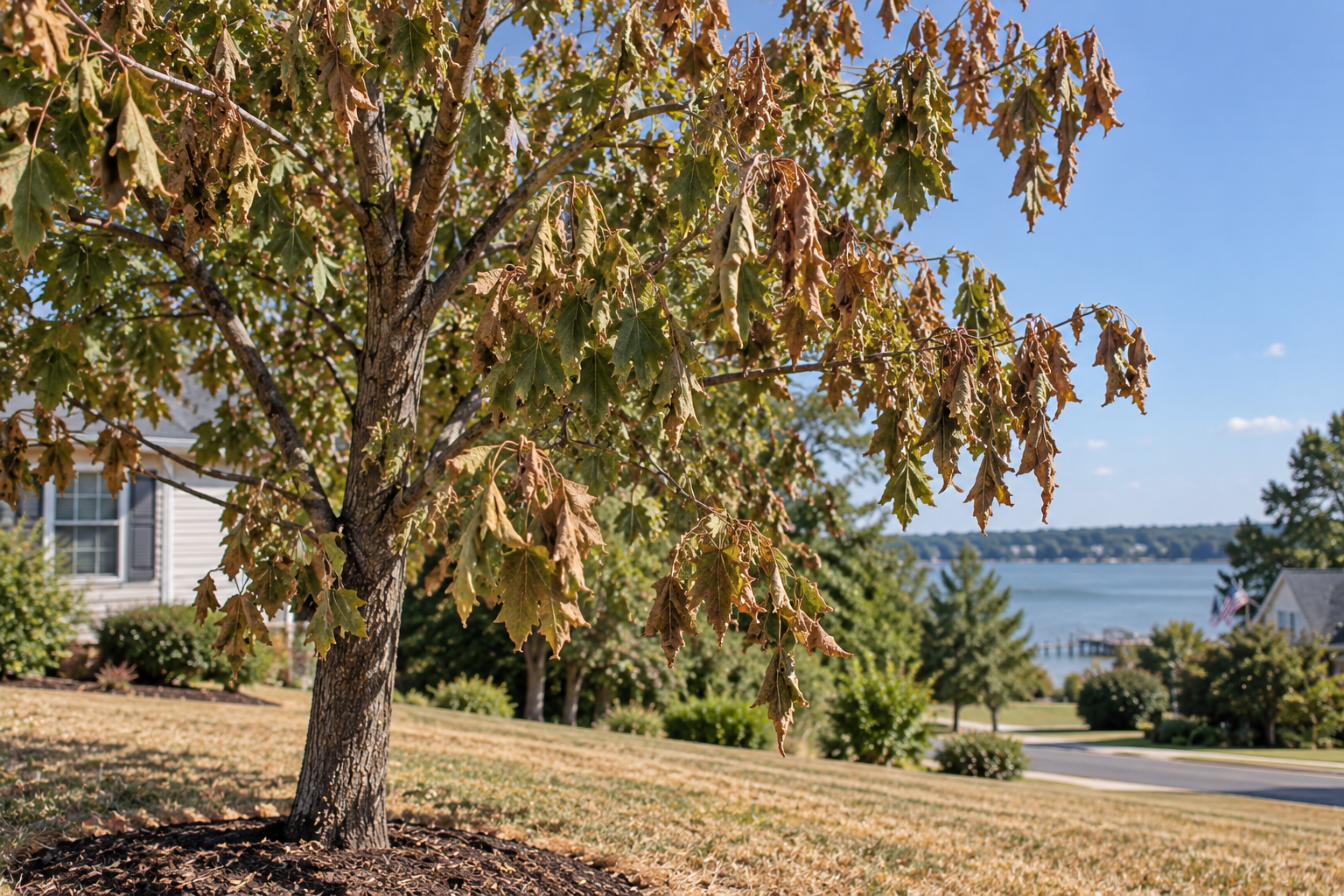
- Scorched, browning leaf edges, especially on maples and other broadleaf species
- Leaves turning yellow or dropping early, well ahead of normal fall color change
- Reduced growth on new shoots compared to previous seasons
3. Advanced signs
- Significant, premature leaf drop, sometimes exposing large portions of the canopy
- Dieback starting at the tips of branches and working inward
- Cracking bark, particularly on the sun-exposed side of the trunk
- Visible wilting that no longer recovers overnight
A tree showing early or moderate signs generally has a good chance of bouncing back with proper watering. Advanced dieback is a signal that the tree may need a full evaluation from an arborist to determine whether it can recover or whether parts of the canopy need to be pruned back.
Which Trees Are Most at Risk
- Newly planted trees are consistently the most vulnerable, since their root systems haven’t yet spread beyond the original planting hole. Most young trees need consistent, deep watering for the first 2 to 3 growing seasons after planting, regardless of typical rainfall, until their roots are established.
- Certain species also tend to show drought stress more visibly and more quickly than others, including dogwoods, Japanese maples, and river birch trees that generally prefer consistently moist soil.
- Mature oaks and hickories tend to be more drought-tolerant once established, though they can even show stress during prolonged dry periods, particularly if their root zones have been disturbed by construction or grading.
What to Do If Your Tree Shows Drought Stress
- Water deeply, not frequently. A slow soak that reaches 12 to 18 inches into the soil encourages deep root growth and is far more effective than daily light watering, which tends to promote shallow roots that are even more vulnerable to future dry spells. A soaker hose left at the base of the tree for an extended period, moved periodically around the drip line, works well for larger trees.
- Mulch the root zone. A 2-3 inch layer of mulch around the base of the tree (kept a few inches away from the trunk itself) helps the soil retain moisture and moderates soil temperature. This is one of the simplest, most effective things a homeowner can do for a stressed tree.
- Avoid fertilizing during active drought stress. Fertilizer can push a stressed tree to put energy into new growth it doesn’t have the water reserves to support, which can worsen the strain. It’s better to focus on water first and address fertilization once the tree has stabilized.
- Check for soil compaction. If water tends to pool or run off rather than soak in around a stressed tree, the surrounding soil may be compacted. Aerating or loosening the soil in the root zone can improve water absorption going forward.
- Get a professional evaluation for advanced symptoms. Significant dieback, cracking bark, or a tree that isn’t responding to consistent watering after several weeks may need a closer look from an experienced tree service firm in Southern Maryland to determine whether pruning, treatment, or removal is the right next step.
Long-Term Drought Resilience
Beyond responding to an active dry spell, a few longer-term steps help Southern Maryland trees handle future droughts better:
- Choosing drought-tolerant species for new plantings in exposed or well-drained areas
- Maintaining a consistent mulch layer year-round rather than only during dry stretches
- Avoiding soil compaction from vehicles, equipment, or heavy foot traffic near the root zone
- Having trees inspected periodically so early stress is caught before it becomes severe
Empire Tree Services helps homeowners identify drought stress and determine how severely a tree has been affected. Our experienced arborists can assess wilting, leaf scorch, premature leaf drop, and branch dieback to identify potential causes. They can recommend appropriate watering, pruning, and tree-care measures based on the tree’s condition. If symptoms continue despite proper care, our team can check for pests, disease, root problems, or other underlying issues.
Frequently Asked Questions About Drought Stress in Southern Maryland Trees
How much rain does a mature tree need during a dry summer?
It varies by species and soil type, but as a general guideline, most established trees benefit from roughly one inch of water per week during hot, dry stretches, either from rainfall or supplemental watering.
Can a tree recover after showing drought stress?
Many trees recover fully once consistent watering resumes, particularly if symptoms were caught in the early or moderate stages. Advanced dieback may require corrective pruning, and severely affected trees may not fully recover.
Is it possible to overwater a tree while trying to fix drought stress?
Yes. Waterlogged soil can suffocate roots and cause its own set of problems. Deep, infrequent watering that allows the soil to partially dry between sessions is generally safer than constant watering.
Do drought-stressed trees need to be watered differently than healthy trees?
Stressed trees generally benefit from the same deep-watering approach as healthy trees, just applied more consistently until symptoms improve.
When should I call an arborist instead of just watering more?
If a tree shows significant branch dieback, cracking bark, or doesn’t respond to several weeks of consistent watering, it’s worth having a professional assess whether the issue goes beyond drought stress alone.
Summary Checklist: Responding to Drought Stress
| Situation | What to Check | What to Do |
| Leaves wilting during the day | Recovery overnight | Begin deep watering routine |
| Leaf scorch or early yellowing | Extent and progression | Continue watering, add mulch |
| Recently planted tree in a dry stretch | Root establishment | Water deeply 1–2 times weekly |
| Branch tip dieback | How far it has progressed | Schedule a professional evaluation |
| Water pooling or running off | Soil compaction | Aerate or loosen root zone soil |
| No improvement after weeks of watering | Overall tree condition | Get an arborist assessment |
Final Advice
Drought stress in Southern Maryland is easy to overlook, since the region isn’t typically associated with dry conditions the way other parts of the country are. But clay soils, compacted yards, and stretches of summer heat can put real strain on trees, especially younger ones. Catching the early signs and responding with deep, consistent watering gives trees the best shot at bouncing back before stress turns into lasting damage.
If you’re noticing wilting, scorched leaves, or dieback on a tree anywhere on your property, Empire Tree Services can take a closer look and help you figure out whether it’s drought stress, a deeper structural issue, or something in between.
Reviewed by a Licensed Arborist
This article has been reviewed by a licensed arborist to ensure the accuracy of the information and recommendations related to identifying and managing drought stress in Southern Maryland trees.
Sources & Credible References