
April 15, 2026
Southern Maryland’s coastal plain environment, with its heavy humidity and seasonal storm surges, provides a lush backdrop for the mighty Oak. Whether it is the towering White Oak, Maryland’s state tree, or the resilient Willow Oak, these giants are the backbone of our local canopy. However, the combined pressure of suburban development, changing water tables in counties like St. Mary’s and Calvert, and specific local pathogens can bring these sentinels to their knees. Recognizing the early symptoms of decline is the only way to intervene before a majestic Oak becomes a hazardous liability.
Key Takeaways
- The “Top-Down” Tell: Oak decline almost always starts at the very tips of the upper canopy.
- Local Pathogen Alert: Bacterial Leaf Scorch and Hypoxylon Canker are the leading “silent killers” in the Chesapeake watershed.
- Structural Integrity: Mushrooms at the base (root flare) often signal internal rot that isn’t visible on the bark.
- Leaf Clues: Off-season color changes or “clumped” foliage are cries for help.
What Causes Oak Decline in Southern Maryland?
Oak decline is rarely caused by a single event. Instead, it is a “syndrome” resulting from a combination of environmental stressors and biological invaders. In our region, the high clay content in some inland soils and the sandy, fast-draining soils of the coastal areas create different stress profiles. When an Oak is stressed by drought or construction compaction, its natural chemical defenses drop, inviting pests that would otherwise be ignored.
How to Identify a Dying Oak: The Visual Progression
An Oak tree rarely dies overnight. It follows a predictable pattern of physiological failure that a keen homeowner can spot from the ground.
Canopy Dieback and “Stagheading”:
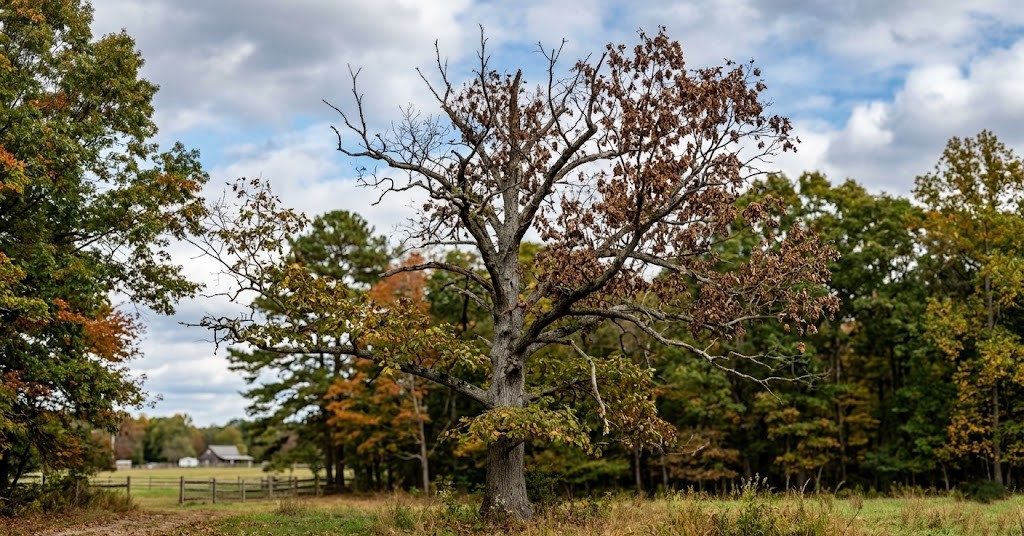
The most prominent sign of a dying Oak is dieback in the upper crown. If the topmost branches are leafless and brittle while the rest of the tree is green, the tree is “stagheading.” This indicates the vascular system is no longer strong enough to pump water against gravity to the highest points. If more than 30% of the upper canopy is dead, the tree is in a state of advanced decline.
Bacterial Leaf Scorch (BLS)
Specific to the Mid-Atlantic, BLS is a chronic disease spread by leafhopper insects. Unlike drought stress, where the whole leaf turns brown, BLS creates a “burned” look on the leaf margins with a distinct yellow “halo” or band between the brown edge and the green center. In Southern Maryland, we see this most frequently in Pin Oaks and Red Oaks.
Bark Abnormalities and “Bleeding”
Healthy oak bark should be tight and consistent. If you notice deep cracks, “seeping” wet spots (fluxing), or large sections of bark sloughing off to reveal smooth wood underneath, the cambium layer – the tree’s living tissue is dying.
The “Secondary” Invaders: Pests and Fungi
When an Oak’s immune system is compromised, specific organisms move in to accelerate the decomposition process. In Maryland, these are the most common “red flags.”
Hypoxylon Canker: This fungus is a tell-tale sign of a stressed tree. It appears as smooth, tan-to-silver-gray patches under the bark. As the fungus matures, it turns black and “crusty.” Once Hypoxylon appears, the tree’s internal water-conducting tissues are usually too far gone to save.
The Two-Lined Chestnut Borer: This beetle is the primary “finisher” of weakened Oaks. Look for small, D-shaped exit holes in the bark and “winding” galleries underneath the bark surface. These larvae effectively “girdle” the tree, cutting off the flow of nutrients between the roots and the leaves.
Root Rot and Ganoderma Mushrooms: If you see shelf-like mushrooms (conks) growing at the base of the trunk or on the ground near the roots, the tree has internal heartwood rot. In Southern Maryland’s wet springs, these fungi thrive. They eat the structural lignin of the roots, meaning the tree could look green on top but be completely unstable at the base.
The “Construction Curse” in Waldorf
I recently visited a property in Waldorf where a massive White Oak was dying in the middle of a beautiful new lawn. The homeowner couldn’t understand why; they watered the grass every day. The problem? During the construction of the new driveway and patio, heavy machinery had driven over the root zone.
Oaks have “critical root zones” that extend far beyond the branches. The weight of the equipment crushed the soil pores, suffocating the roots (soil compaction). In Southern Maryland, compaction is the #1 leading cause of Oak death in suburban areas. If you are building near an Oak, the root zone must be fenced off to save the tree’s life.
Strategic Solutions: Can a Dying Oak Be Saved?
Whether an Oak can be saved depends entirely on how much “living” tissue remains.
- Vertical Mulching and Soil Aeration: For trees suffering from compaction or poor drainage, a professional can use high-pressure air (Air-Spade) to loosen the soil and incorporate organic matter without damaging the roots. Learn more: USDA Forest Service: Tree Protection and Soil Management
- Growth Regulators: Certain applications, like Paclobutrazol, can slow down canopy growth and redirect the tree’s energy into root production and defense chemicals. Learn more: Purdue University Extension: Using Tree Growth Regulators
- Targeted Micro-Injections: If the tree is in the early stages of a pest infestation or BLS, direct trunk injections can deliver medicine straight into the vascular system, bypassing the soil. Learn more: University of Maryland Extension: Managing Bacterial Leaf Scorch
Frequently Answered Questions
Q1. Is a “hollow” Oak tree always a dead tree?
Not necessarily. The center of an Oak (heartwood) is actually dead tissue used for support. A tree can be hollow and still have a healthy, living “sapwood” outer ring. However, it may be a structural risk during high-wind events.
Q2. What is “Oak Wilt,” and do we have it in Southern Maryland?
Oak Wilt is a devastating fungal disease. While more common in the Midwest, it has been detected in Maryland. It causes rapid wilting and leaf drop in mid-summer. It is a mandatory reporting disease in many areas.
Q3. Why is my oak tree dropping green leaves in July?
This is often a “drought response.” The tree is shedding weight and surface area to reduce water loss. If the leaves are green and healthy, the tree is likely just stressed, not dying.
Q4. Does “borer dust” mean the tree is dead?
“Frass” (fine sawdust) in the bark crevices means active insects are eating the tree. It is a sign of severe stress, but if caught early, systemic insecticides can sometimes stop the spread.
Q5. Can I prune a dying Oak to save it?
Removing dead wood is healthy, but never “top” an Oak or remove more than 25% of the living canopy. Pruning should only be done in the dormant winter months to prevent attracting beetles that carry diseases.
Q6. How long does it take for a stressed Oak to actually die?
Oaks are slow-motion giants. A “dying” Oak can linger for 3 to 5 years before it becomes a total loss. This window is your opportunity for intervention.
Q7. Is it safe to leave a dying Oak standing if it’s far from the house?
Dead Oaks provide excellent habitat for local wildlife like woodpeckers and owls. If the tree is not within “striking distance” of a structure, driveway, or power line, leaving it as a “wildlife snag” is an ecologically sound choice.
Q8. When is it officially time to remove the tree?
If more than 50% of the canopy is dead, if there are large fungal fruiting bodies at the base, or if the trunk shows significant structural cracks, removal is the safest option.
Conclusion
The Oaks of Southern Maryland are resilient, but they are not immortal. By identifying signs like “stagheading,” leaf scorch, and fungal conks early, you can take action to preserve these historic landmarks. Remember, an Oak is an investment in your property’s value and the local ecosystem’s health. A Professional Tree Service can help you identify these early warning signs and implement a preservation plan before the damage becomes irreversible.
Reviewed by Empire Tree Services
This safety analysis has been reviewed by the team at Empire Tree Services to ensure accuracy based on hands-on tree care experience, soil behavior, and real-world tree risk scenarios.