
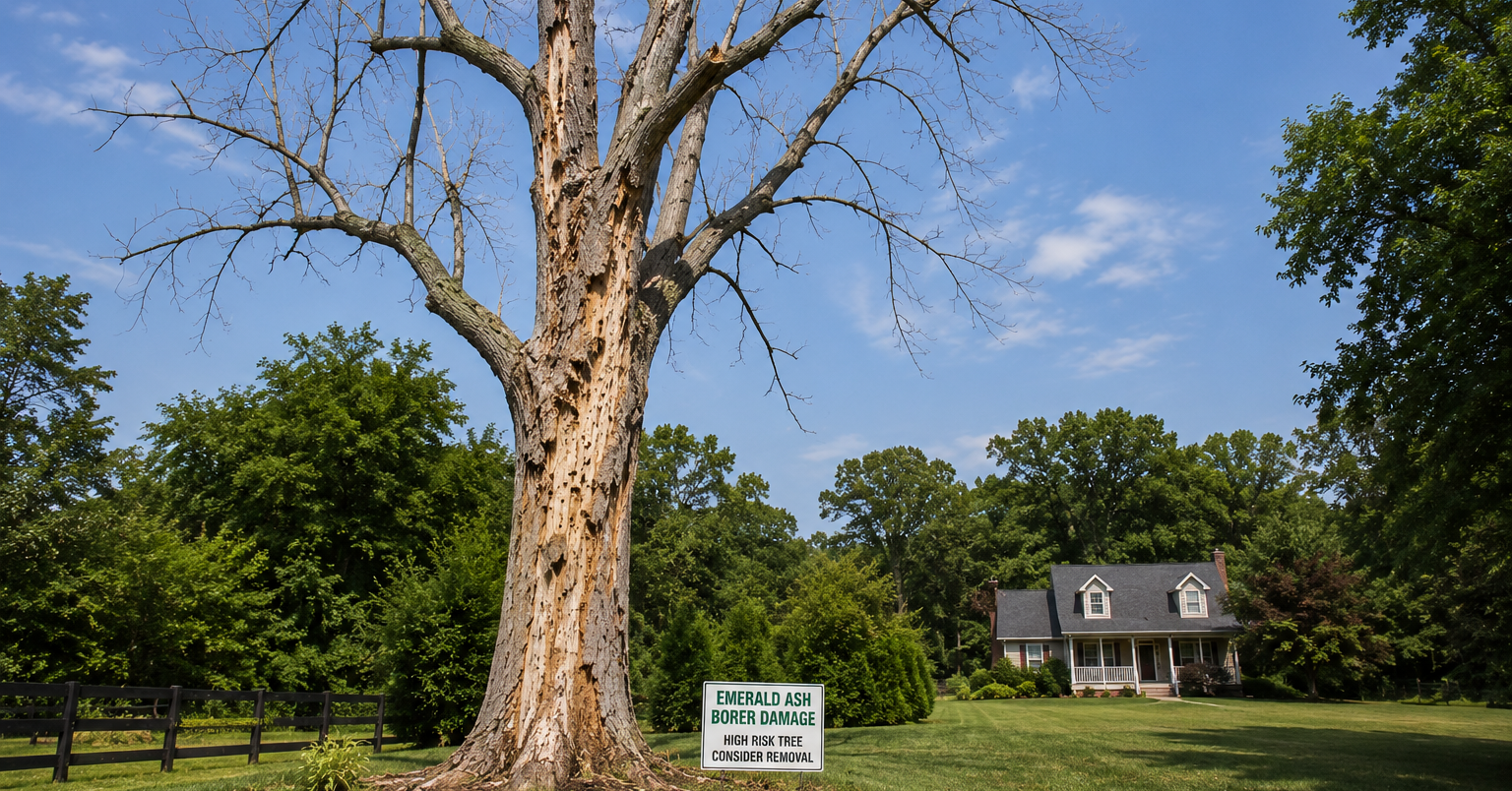
Key Takeaways
- Vascular Destruction: EAB larvae girdle the tree, cutting off water and nutrient flow almost instantly.
- Rapid Dehydration: Unlike Oaks, Ash wood loses moisture at an accelerated rate, becoming glass-like and brittle.
- The Shatter Factor: Dead Ash wood is prone to splintering and shattering upon impact, making DIY removal lethal.
- Non-Climbable Hazards: Once an Ash tree is 100% dead, it is often too brittle for arborists to climb safely.
- Proactive Removal: Waiting for a storm to bring down an Ash tree often results in mid-trunk snaps rather than uprooting.
For decades, the Ash tree was a cornerstone of the Southern Maryland landscape. Known for its strength and symmetrical canopy, it was a favorite for both residential shade and municipal planting in communities like Mechanicsville and Leonardtown. However, if you take a drive through St. Mary’s County today, the scenery has changed. You will see standing skeletons, leafless, gray, and dangerously brittle trees.
The culprit is the Emerald Ash Borer (EAB), an invasive metallic green beetle that has decimated millions of trees across North America. In Mechanicsville, we have reached a critical tipping point. The infestation phase has transitioned into the failure phase, where trees that were infected a few years ago are now becoming structural hazards. To protect your property, you must understand why EAB makes wood so uniquely brittle and why waiting to remove these trees is a gamble you likely will not win.
The Biology of the Invasion: How EAB Kills
The Emerald Ash Borer is a small wood-boring beetle native to Asia. While the adult beetles nibble on foliage, they cause very little damage. The real killers are the larvae. When an adult female lays her eggs in the crevices of Ash bark, the hatching larvae immediately bore into the tree’s cambium layer, the vital plumbing system located just beneath the bark.
This layer contains the phloem and xylem, which transport water and nutrients between the roots and the leaves. The larvae create S-shaped galleries as they feed, effectively girdling the tree. In Mechanicsville’s climate, a healthy Ash tree can be completely stripped of its ability to move water in as little as two to three years. Once the vascular system is destroyed, the tree begins to die from the top down.
Why EAB Wood is Uniquely Dangerous and Brittle
Most homeowners are used to Oaks or Maples that stay standing for years after they die. Ash trees are different. Ash wood is naturally ring-porous, meaning it has large vessels that move water rapidly. When EAB larvae disrupt this flow, the wood dries out at an accelerated rate.
1. Loss of Internal Moisture
Because the EAB larvae destroy the tree’s ability to transport water, the wood fibers lose their elasticity almost immediately. While a living tree can bend and sway in the wind, an EAB-infested Ash becomes rigid and brittle. The moisture content drops so significantly that the wood becomes prone to brittle failure, where it snaps under the slightest pressure rather than bending.
2. The Shatter Effect
When a professional crew removes a typical dead tree, the wood usually stays in large, manageable chunks. However, Ash trees killed by EAB are known in the industry for shattering. Upon impact with the ground or even while being cut, the wood can splinter into thousands of sharp shards. This makes the removal process significantly more dangerous for amateur woodcutters and emphasizes the need for specialized rigging and heavy machinery.
3. Separation of Bark and Sapwood
As the larvae feed, they physically separate the bark from the underlying wood. This creates vertical bark splitting. In a Southern Maryland storm, these large sheets of bark can fly off, but more importantly, the lack of bark allows the sun to bake the exposed wood, even further accelerating the drying process until the tree is a standing tinderbox.
5 Reasons Your Ash Trees are Now Brittle
1. Larval Girdling of the Cambium Layer
The primary cause of brittleness starts with the Emerald Ash Borer larvae boring into the tree. These invasive pests feed on the cambium layer, the thin strip of living tissue responsible for growth. As they create S-shaped galleries, they effectively girdle the tree, cutting off the vital connection between the roots and the canopy.
2. Destruction of the Vascular System
Once the cambium and the surrounding transport tissues are destroyed, the tree’s vascular system fails. This system is responsible for moving water and essential nutrients. Without a functional internal plumbing system, the tree cannot hydrate its limbs, causing the wood to begin dying from the inside out almost immediately.
3. Rapid Dehydration of Ring-Porous Wood
Ash trees are naturally ring-porous, meaning they have large, open vessels designed to move massive amounts of water quickly. While this is an advantage for a healthy tree, it becomes a liability during an infestation. Once the water supply is cut off, these large vessels allow the remaining moisture to evaporate at an accelerated rate compared to denser wood species like Oak or Maple.
4. Total Loss of Wood Elasticity
Healthy wood fibers are designed to be flexible, allowing a tree to sway and give under the pressure of the wind. However, the rapid dehydration caused by EAB leads to a total loss of elasticity. The wood fibers become stiff and rigid, losing the organic spring that usually keeps a tree’s crown safe during Southern Maryland’s frequent windstorms.
5. Transition to a Glass-Like State
As the moisture content drops to critical levels, the chemical structure of the Ash wood changes, becoming glass-like in its fragility. Instead of bending or leaning when under stress, the trunk and branches become prone to shattering or snapping suddenly. This brittle failure often happens without warning, causing the tree to break into sharp fragments rather than falling in one cohesive piece.
The Financial and Safety Risks of Inaction
Southern Maryland experiences high-velocity wind gusts and heavy humidity. An Ash tree that has been dead for more than a year is a ticking time bomb. Because EAB wood is so brittle, these trees do not always fall over at the root. Instead, they snap mid-trunk. A 70-foot Ash tree snapping 30 feet up can send the top half of the tree through a roof or a power line with zero warning. There is no slow lean with an Ash; there is only the snap.
Furthermore, the longer you wait, the more expensive the removal becomes. Tree service companies base their pricing on risk. An Ash tree that is still 50% alive can often be climbed safely by an arborist. A tree that is 100% dead and brittle is often too dangerous to climb. This requires the use of heavy cranes or bucket trucks to remove the tree from the top down without putting a climber in the canopy. Waiting until the tree is completely dead can double your removal costs due to the specialized equipment required to handle brittle wood safely.
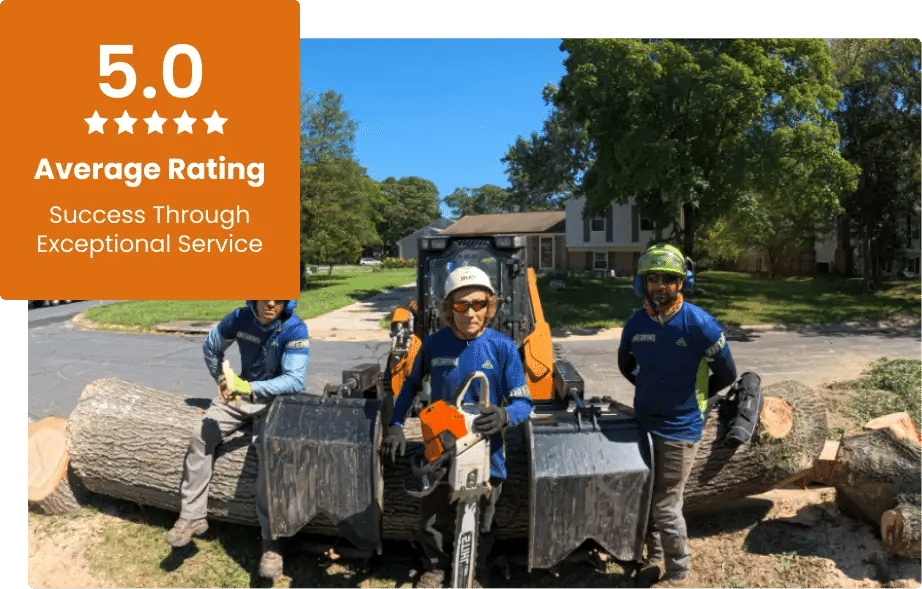
If your Ash trees in Mechanicsville are showing signs of EAB infestation, Empire Tree Services is Southern Maryland’s leading expert in managing the unique risks of brittle wood removal. Serving St. Mary’s, Charles, and Calvert Counties, our 5-star rated team specializes in the safe extraction of hazardous Ash trees that have lost their structural elasticity.
Empire Tree Services is fully licensed, bonded, and insured, utilizing advanced rigging and cranes to prevent the catastrophic mid-trunk snaps that occur when these “glass-like” trees fail. Don’t wait for a storm to shatter your brittle Ash trees; call us today at (240) 249-7773 for a free consultation and professional assessment.
Frequently Asked Questions
1. Can I treat my Ash tree instead of removing it?
If the tree has lost less than 30% of its canopy, systemic insecticide treatments can sometimes save it. However, these treatments must be repeated every two years for the life of the tree. In Mechanicsville, most Ash trees are already past the point of no return.
2. Why are Ash trees more dangerous than dead Oaks?
Oak wood is much denser and retains moisture longer, allowing it to remain structurally sound for several years after death. Ash wood dries out rapidly due to its ring-porous structure, making it prone to snapping suddenly without warning.
3. Does homeowners’ insurance cover Ash tree removal?
Usually, insurance only pays if the tree falls and hits a covered structure like your house or fence. They rarely pay for preventative removal, even if the tree is dead. This is why it is vital to remove them before they cause a massive claim.
4. What should I do with the wood after the tree is removed?
Do not move Ash firewood! EAB is spread primarily by people moving infested wood to new areas. You should have the wood chipped, mulched, or burned on-site to prevent spreading the beetle to other parts of Maryland.
5. How do I know if I have an Ash tree?
Ash trees have opposite branching, meaning twigs and leaves grow in pairs directly across from each other. They also have compound leaves with 5 to 9 leaflets on one stalk and bark with a distinct diamond-shaped pattern.
6. Is EAB still active in Southern Maryland?
Yes. While the initial wave has passed, the beetle continues to move through remaining pockets of Ash trees in St Mary’s and Charles Counties.
7. Can brittle Ash wood be used for furniture?
If the wood is harvested soon after death, it can still be used. However, once the decay sets in and the wood becomes brittle, it loses the structural integrity required for fine woodworking.
8. Will EAB attack my other trees?
No. Emerald Ash Borer is host-specific and only attacks trees in the Fraxinus genus. Your Maples, Oaks, and Pines are safe from this specific pest.
Summary Checklist: Ash Tree Emergency Signs
| Sign of Danger | Risk Level | Recommended Action |
| Heavy woodpecker activity or flecking | High | Schedule a professional structural assessment because severe insect infestation is likely present |
| Bark peeling or falling off in large sheets | Critical | Request immediate removal because the wood underneath is dry, brittle, and structurally unstable |
| Complete canopy dieback | High | Use crane-assisted removal because dead trees with total canopy loss are unsafe to climb |
| D-shaped exit holes in bark | Moderate | Evaluate the tree quickly because the infestation is active, and structural decline will worsen over time |
| Epicormic sprouting along the trunk | Moderate | Inspect for vascular failure and overall tree decline caused by severe environmental or insect stress |
Final Advice
The Emerald Ash Borer has fundamentally changed the safety profile of Southern Maryland’s forests. For residents in Mechanicsville, the window of opportunity for easy removals is closing as these trees become increasingly unstable and brittle. If you have a tall Ash tree within striking distance of your home driveway or power lines, you must treat it as a high-priority hazard. The physics of brittle Ash wood does not allow for a graceful failure; when these trees go, they shatter or snap with immense force. Taking ten minutes to inspect your trees for flecking or dieback is the best way to prevent a catastrophic property loss. Professional removal while the tree still has some structural integrity is significantly safer and more affordable than waiting for a winter storm to settle the matter for you. By being proactive, you protect your landscape and ensure that a failing tree does not become a dangerous liability for your family or your neighbors.