
November 13, 2026
Nor’easters and tropical storms can damage tulip poplars through prolonged wind loading, broken upper limbs, lost leaders, trunk or codominant-stem splits, and hidden cracks that remain after the weather clears. Heavy rain can saturate the ground, reduce root stability, and contribute to root-plate movement or uprooting. Some nor’easters also add wet snow or ice to the canopy.
That doesn’t mean every tulip poplar will fail in severe weather. The outcome depends on the tree’s structure, age, health, root condition, exposure, soil drainage, previous pruning, and distance from buildings or other targets. A tall tree with sound branch unions and stable roots may respond very differently from a similar tree with decay, an old split, or recent root damage.
Tulip-Poplar Characteristics That Affect Storm Response
Tulip poplar (Liriodendron tulipifera), also called tuliptree or yellow-poplar, is a fast-growing hardwood in the magnolia family. It isn’t a true poplar. The species can grow very tall, but height and rapid growth don’t automatically make an individual tree unsafe.
Tulip poplar is one of the taller eastern hardwoods. In a forest, it often develops a long, straight trunk as it competes for overhead light. In an open yard, the same species may form a broader crown with large lateral branches that receive wind more directly.
North Carolina State Extension notes that tulip poplars can be susceptible to limb breakage in high wind or under ice and snow loads. That is a species tendency, not a prediction for every tree. Crown shape, branch attachments, old wounds, decay, root space, and exposure usually tell us more about a particular tree than its name alone.
A tree can also become newly exposed after neighboring trees are removed. Its trunk and roots developed under one wind environment, then the crown begins receiving stronger or less filtered wind. That change doesn’t guarantee failure, but it belongs in a full review of the tree and its surroundings.
Nor’easters and Tropical Storms Load Trees Differently
Both storm types can bring wind and heavy rain to Calvert County, but they don’t form in the same way. A nor’easter develops along the East Coast and draws energy from contrasts involving colder air. A tropical storm develops from a tropical cyclone over warm water and is classified partly by sustained wind speed.
| Storm Factor | Nor’easter | Tropical Storm | Possible Tulip-Poplar Damage |
|---|---|---|---|
| Wind pattern | May be prolonged and change direction as the system moves | Sustained wind with stronger gusts; direction may shift | Repeated crown movement, cracked unions, broken leaders |
| Precipitation | Rain, flooding, or sometimes heavy wet snow and ice | Heavy rain and possible inland or tidal flooding | Saturated soil, root movement, added canopy weight |
| Additional hazards | Coastal flooding and cold-weather loading | Tornadoes and severe rain bands | Sudden trunk, branch, or root failure |
Nor’easters Can Create Long-Duration Crown Stress
Nor’easters can expose a tall tulip poplar to hours of wind, cold rain, and repeated movement. According to NOAA’s explanation of nor’easters, these East Coast systems may produce rain, flooding, strong gusts, heavy snow, or blizzard conditions. The exact mix changes from storm to storm.
That distinction matters in Southern Maryland. Some nor’easters reach Calvert County mainly as wind-and-rain events. Others may bring wet snow or ice that collects on branches. Added weight can pull upper limbs downward while wind pushes the crown sideways, placing several forces on a branch union at once.
Long periods of movement can also exploit a weakness that was already present. A narrow branch union, internal decay, an old pruning wound, or damage from an earlier storm may begin to crack. The upper leader may snap, a large limb may tear away, or two main stems may split where they join.
Changing wind direction matters as well. A branch that flexed with an early wind may later be pushed from another angle as the storm passes. The repeated loading doesn’t mean an otherwise sound tree must fail, but it can expose defects that were not visible before the event.
Tropical Storms Combine Wind With Water-Related Stress
A tropical cyclone becomes a tropical storm when its maximum sustained winds reach at least 39 mph. NOAA’s tropical-cyclone classification also makes clear that wind speed doesn’t describe every hazard. Heavy rainfall, inland flooding, and tornadoes may accompany a tropical system.
For a tulip poplar, the order of events can be as important as the storm’s classification. Heavy rain may arrive before the strongest gusts, leaving the root zone wetter by the time the canopy begins moving. Prolonged wind then pushes on a tall crown while the roots depend on soil that may offer less resistance than it did before the rain.
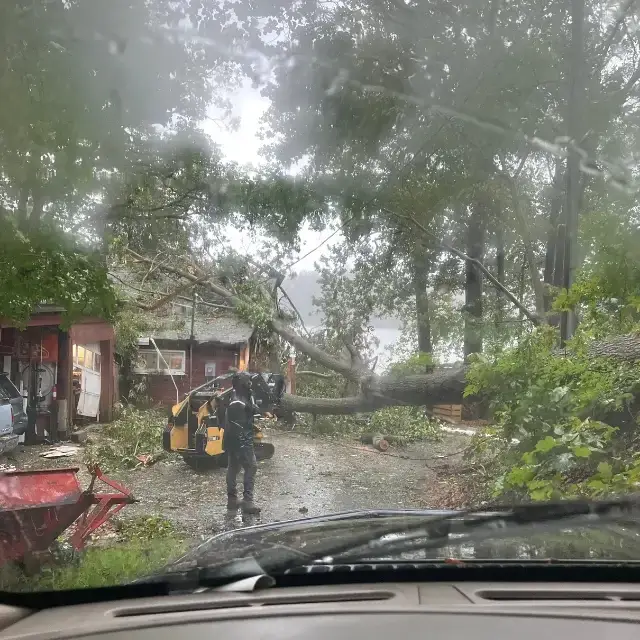
Tropical rain bands can also produce abrupt gusts or tornado-related damage. A branch or leader may twist and fracture rather than break cleanly. Trunks with codominant stems can split, and a compromised root system may shift or rotate in the soil.
Calvert County’s official wind-related hazard guidance identifies strong wind, falling trees, downed power lines, and flooding associated with tropical storms and nor’easters as local concerns. Conditions still vary widely among an inland yard near Prince Frederick, a waterfront property near Broomes Island, and a more sheltered site elsewhere in the county.
Branch Unions Often Determine Where Damage Begins
Large upper limbs and leaders receive considerable wind because of their height and exposure. Failure often begins at an attachment, wound, or decayed area rather than in an undamaged section of straight trunk. This is why two tulip poplars of similar size can perform very differently in the same storm.
Codominant stems are two trunks or leaders of similar size growing from the same union. If bark becomes trapped between them, the condition is called included bark. Instead of forming a strong wood connection, the stems press against bark within a narrow junction, making that union more vulnerable to splitting.
Other details can influence branch performance:
- A large limb attached at a narrow angle
- An old pruning wound that has not fully closed
- A cavity or area of decay near a major union
- A branch weakened by previous storm damage
- Dead wood in the upper crown
- An unbalanced canopy with much more growth on one side
Wind may bend and twist those parts repeatedly. Ice or wet snow can increase the downward load during some nor’easters. If a leader breaks high in the crown, it may become hung in lower branches, fall clear of the tree, or leave a torn opening where water and decay organisms can enter.
Saturated Soil Can Reduce Root Support
Heavy rain doesn’t make every healthy tree fall. Uprooting usually reflects a combination of wind force, soil condition, root architecture, root damage, decay, lean, and exposure. Poor drainage or already damaged roots can make the same rainfall more consequential on one property than another.
The University of Maryland Extension explains that excess soil moisture reduces oxygen and can damage fine roots. During a storm, saturated or softened soil may also provide less resistance as the trunk and crown move. The root plate, the mass of large roots and soil that helps anchor the tree, may begin to lift or rotate.
Visible soil cracking on one side of the trunk and mounding on the other can signal movement. Freshly exposed roots or a new lean are also reasons to keep people away from the potential fall area. A tree can settle into a slightly different position without falling immediately, so the end of the storm doesn’t necessarily end the concern.
Waterfront, low-lying, sloped, and poorly drained properties can face different combinations of wind and soil stress. We don’t assume one soil condition applies across all of Calvert County. Site drainage, recent excavation, construction traffic, erosion, root cutting, and the removal of nearby trees all need to be considered individually.
Hidden Damage May Remain in a Standing Tree
A standing tulip poplar can still carry significant storm damage. Large cracks may be hidden where branches meet high in the canopy, while smaller fractures can be concealed by leaves. A quick look from a doorway or driveway may miss a partially detached limb above the normal line of sight.
Post-storm damage may include:
- Cracks at major branch unions
- Partially detached or hanging limbs
- Twisted and fractured upper branches
- A broken or missing upper leader
- Fresh vertical or diagonal trunk cracks
- A new lean or change in trunk position
- Lifted or cracked soil around the base
- Freshly exposed roots
- Torn bark below a failed branch
- A canopy that suddenly looks open or heavier on one side
Listen and observe only from a safe location. Unusual creaking or visible movement in calm conditions can indicate that damaged wood is shifting. Damage high in the canopy may require a closer professional view, but homeowners shouldn’t climb the tree or stand beneath it to get a better picture.
Hidden damage can also become clearer over the following days. Leaves may wilt on a cracked limb whose water supply has been partly interrupted. A branch that appeared supported may settle lower, and disturbed soil around the base may become easier to see after surface water drains away.

Warning Signs That Deserve Professional Attention
The strongest reason to request an evaluation is a visible change in structure, especially when the tree could reach a home, vehicle, driveway, utility line, or frequently used area. We recommend keeping people and pets away while the condition is uncertain.
Look for:
- A new lean or a lean that has noticeably increased
- Soil lifting, cracking, or separating around the trunk
- Newly exposed, broken, or pulled roots
- A split through the trunk or a major union
- Hanging or partly broken limbs
- A missing upper leader or large section of crown
- New gaps or obvious imbalance in the canopy
- Bark torn away where a branch failed
- Limbs resting on a roof, utility line, or neighboring tree
- Unusual creaking, shifting, or movement after the storm
These signs don’t all lead to the same recommendation. A broken limb and an unstable root plate are different problems. Our team looks at the visible canopy, trunk, base, surrounding targets, and access conditions before discussing appropriate tree-work options.
Property owners can learn more about our work in Prince Frederick and nearby Calvert County communities. We also serve other parts of our Southern Maryland service area, including Dunkirk, Huntingtown, Lusby, and Broomes Island.
Pruning, Monitoring, and Removal Serve Different Situations
Not every storm-damaged tulip poplar needs to be removed. Limited damage may be addressed by pruning when the affected branches can be removed and the main trunk and root system remain stable. Other trees may be retained and watched for changes after the immediate damage is handled.
Tree trimming and pruning may be appropriate for a broken, dead, or hanging branch that can be removed without leaving the tree structurally unsound. Pruning cannot guarantee that another limb will never fail, and it cannot correct an unstable root plate or a major trunk split.
Tree removal may need to be considered when severe root movement, extensive decay, a split main trunk, or major structural loss leaves the tree unable to remain safely in place. The tree’s location matters, too. The consequences of failure are different beside a house or busy driveway than in an unused wooded area.
We look at the entire tree before discussing pruning or removal. The species name alone isn’t a reason to cut down a tulip poplar, and a broken small branch doesn’t automatically mean the rest of the tree is beyond retention.
Post-Storm Safety Comes First
Storm-loaded branches can move without warning, and utility contact adds a separate electrical hazard. Keep this immediate guidance brief and simple, then use our Southern Maryland storm-damage guide for a fuller homeowner checklist.
- Stay away from hanging limbs, split trunks, and leaning trees.
- Treat a tree touching a utility line as an electrical emergency.
- Contact the utility provider before approaching the area.
- Photograph damage only from a safe location.
- Do not climb, cut, shake, or pull down storm-loaded branches.
- Follow instructions from Calvert County and the National Weather Service.
If fallen branches or trees need to be cleared after the site is safe, our storm cleanup service covers fallen trees, limbs, and debris. A tree that presents an immediate hazard may call for emergency tree removal. Never approach a tree or branch that remains in contact with a line until the utility confirms the electrical hazard has been addressed.
Help With a Storm-Damaged Tulip Poplar in Calvert County
A tulip poplar can lose a limb and remain retainable, or it can stay standing while its trunk or root plate has shifted. The right response depends on what changed, where the tree stands, and what it could strike, not on a blanket rule about the species.
We serve Calvert County and other Southern Maryland communities. If your tulip poplar has a new lean, broken upper limbs, a split union, lifted soil, or visible root movement after a nor’easter or tropical storm, contact Empire Tree Services to discuss the visible damage and appropriate tree-work options.