
April 9, 2026
Southern Maryland’s unique climate, characterized by humid summers and sandy coastal plain soils, presents a specific set of challenges for native and ornamental trees. When temperatures soar and rainfall vanishes, trees enter a state of physiological crisis. This guide explains how heat and drought impact our local canopy and what you can do to protect your landscape investment.
Key Takeaways
- Delayed Reaction: Drought stress often manifests months or even years after the dry spell ends.
- Secondary Killers: Heat doesn’t always kill trees directly; it weakens them so pests and fungi can finish the job.
- Soil Matters: Southern Maryland’s sandy soils drain quickly, making trees in areas like St. Mary’s or Calvert County more susceptible than those in clay-heavy regions.
- Strategic Watering: Deep, infrequent watering is the only way to save a stressed tree; shallow sprinkling does more harm than good.
What is Heat Stress and Drought in Trees?
Heat stress occurs when a tree’s internal temperature rises to a point where metabolic processes, like photosynthesis, begin to fail. Drought is a prolonged period of moisture deficiency that prevents a tree from replacing the water lost through its leaves. In Southern Maryland, these two forces often combine to create “evapotranspirational demand,” where the air literally pulls moisture out of the tree faster than the roots can find it in the soil.
How Drought Specifically Impacts Southern Maryland Species
Drought impacts trees by shutting down their ability to transport nutrients and regulate temperature. Because our region sits on the Atlantic Coastal Plain, our soil often lacks the organic matter needed to hold onto water during a July heatwave.
The “Silent” Damage of Cavitation
When a tree can’t find water, the tension in its vascular system (the xylem) becomes too high. This can cause “cavitation,” where air bubbles pop inside the tree’s water-conducting tubes. According to Wikipedia’s overview of xylem, these air embolisms act like a blockage in an artery, permanently preventing water from reaching the upper canopy.
Why Your Oaks and Tulips are Wilting First
Tulip Poplars and White Oaks are staples of our local landscape, but they are “drought-sensitive.” You might notice Tulip Poplars dropping yellow leaves as early as July. This is a self-preservation tactic to reduce the surface area that loses water.
Identifying the Signs of Heat Stress Before It’s Too Late
You can identify heat stress by looking for leaf scorch, premature color change, and “flagging” (wilting tips). In Southern Maryland, we often see “marginal scorch,” where the edges of the leaves turn brown and crispy while the veins stay green.
Warning Signs by Species:
- Evergreens (Leyland Cypress and Pine): Look for needles turning brown from the inside out and a dull graying of the canopy.
- Deciduous (Maple and Oak): Look for drooping leaves that do not perk up at night and crispy brown edges.
- Fruit Trees (Citrus and Stone Fruit): Look for shriveled fruit, a sudden drop of unripe crops, and leaves rolling inward.
Long-term Risks: The “Secondary” Invaders
A drought-stressed tree is like a human with a compromised immune system. In Maryland, the biggest threat following a drought is the Two-Lined Chestnut Borer and Hypoxylon Canker. These opportunistic pests and diseases can sense the chemical signals of a stressed tree from miles away.
If a tree is too far gone, it may become a hazard to your home. In these cases, consulting a tree service company for an evaluation is the safest route to prevent property damage. If the structure is compromised, professional tree removal may be necessary to ensure safety during the high-wind summer storms common in our region.
Field Insight: A Tale of Two Maples in Leonardtown
Last summer, I visited a property in Leonardtown with two identical Red Maples. One was thriving; the other was dying. The difference? The dying tree was surrounded by a beautiful, green, heavily-manicured lawn that was watered for 10 minutes every single morning.
The homeowner thought they were helping, but those 10-minute cycles kept the roots “lazy” and near the surface, where the sun baked them. The thriving tree sat in a mulched bed and received a “deep soak” once a week. This encouraged the roots to dive deep into the cooler, moister subsoil. Stop “sprinkling” your trees; start soaking them.
Strategic Solutions to Combat Drought Effects
The best way to protect your trees is to mimic the forest floor. This involves moisture retention and temperature regulation.
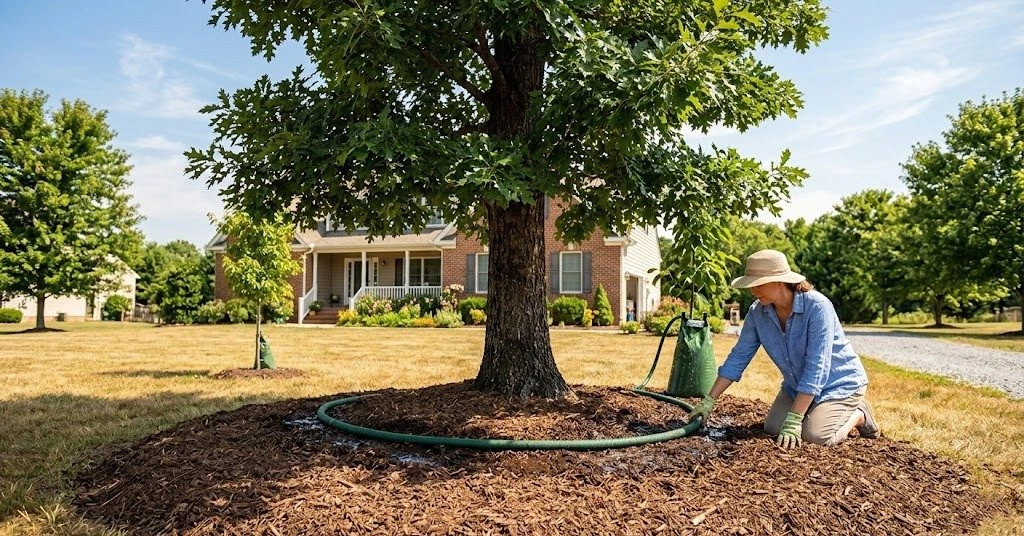
- The 3-3-3 Mulching Rule: Apply a 3-inch layer of organic mulch in a 3-foot radius around the trunk, keeping it 3 inches away from the bark (no “mulch volcanoes”).
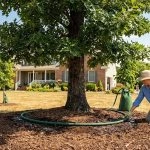
- Targeted Irrigation: Use a soaker hose at the “drip line” – the area directly under the outermost branches where the most active feeder roots live.
- Avoid Fertilizing During Drought: Fertilizer salts can actually pull moisture out of the roots, and nitrogen encourages new growth that the tree cannot support.
Frequently Answered Questions
How much water does a stressed tree actually need?
A general rule is 10 gallons of water per inch of trunk diameter. If your tree is 10 inches wide, it needs 100 gallons of water per week during a Maryland dry spell.
Can a tree recover from drought once the leaves turn brown?
It depends. If the buds for next year are still green and pliable, the tree is likely just dormant. If the twigs are brittle and snap easily, that section of the tree is likely dead.
Does mulch really make that much of a difference?
Yes. Mulch can lower soil temperatures by as much as 10–15 degrees and reduce evaporation by over 50%. It is the single most cost-effective way to save a tree.
Should I prune my tree during a heatwave?
No. Pruning creates “wounds” that the tree must expend energy to seal. It also opens up the inner canopy to “sunscald,” where the bark actually burns from direct UV exposure.
What is “Sunscald” on Maryland trees?
This happens when the sun heats up the bark excessively, killing the living tissue underneath. We see this often on young Maples and Willows in Southern Maryland.
Is my tree dead or just dormant?
Use the “Scratch Test.” Gently scratch a small bit of bark off a twig. If it’s green underneath, there’s life. If it’s brown and dry, that limb is gone.
Why are the interior needles of my pine trees falling off?
This is often “seasonal needle drop,” which drought can accelerate. Trees shed older, less efficient interior needles to save energy for the new tips.
When is it time to call an arborist?
If you see large cracks in the trunk, sawdust (frass) from boring insects, or if more than 30% of the canopy fails to leaf out in the spring, professional intervention is required.
Reviewed by Empire Tree Services
This safety analysis has been reviewed by the team at Empire Tree Services to ensure accuracy based on hands-on tree care experience, soil behavior, and real-world tree risk scenarios.