
January 12, 2026
A leaning tree in your yard can raise questions and worries. Is it safe to leave standing, or is it a disaster waiting to happen? Should you try to fix it, or is removal the only solution? These are common concerns for homeowners who notice a tree beginning to tilt.
This guide explains the causes of leaning trees, the difference between safe and hazardous leans, professional solutions, costs, and the right steps to take immediately. By the end, you will know exactly what to do if you have a leaning tree in your yard.
Understanding Why Trees Lean
Trees lean for many different reasons, and the cause often determines the level of risk.
- Storm impact: Heavy winds, rain, and saturated soil can loosen roots and shift a tree suddenly.
- Soil conditions: Shallow or poorly draining soils make it harder for trees to anchor firmly.
- Planting mistakes: Trees planted too deep, too shallow, or without support when young may never grow straight.
- Competition for sunlight: A tree surrounded by taller structures or other trees often leans toward available light.
- Root injury: Damage from trenching, construction, or pests weakens root stability.
- Uneven growth: A lopsided canopy with heavy branches on one side can cause imbalance.
Each of these situations changes how an arborist evaluates the tree and whether corrective action is possible.
When a Leaning Tree Is Not a Problem
Not every leaning tree is dangerous. Some live safely at an angle for decades without issues. You can often relax if:
- The tree has leaned in the same direction for years without worsening.
- It is a small or young tree that naturally bends toward the sun.
- The trunk and branches look healthy with no signs of rot or decay.
- The soil at the base is stable with no cracks or root lift.
An arborist may confirm that such a tree poses no real threat, and it may simply be part of your landscape’s character.
Warning Signs of a Hazardous Lean
Other times, a leaning tree is a serious safety risk. Watch for these red flags:
- The lean appeared suddenly after a storm.
- The trunk has visible cracks or splits.
- Soil around the base is cracked or raised, showing root lift.
- The tree leans sharply toward your home, driveway, or power lines.
- More than 15 degrees of tilt is visible.
- Dead branches or a thinning canopy are present.
If you see one or more of these signs, treat the tree as unstable and call an arborist immediately.
What to Do Immediately if a Tree Starts Leaning
If you notice a new lean in your yard, act quickly.
- Keep distance: Do not let children, pets, or cars near the tree until it is inspected.
- Look for electrical hazards: If the tree is in contact with power lines, contact your utility provider first.
- Check the base: Soil cracks or roots pushing upward indicate instability.
- Call a qualified arborist: Only a professional can confirm whether the tree is safe to save.
- Avoid do-it-yourself fixes: Pulling or tying a large tree upright can make the problem worse and cause injury.
How Arborists Evaluate a Leaning Tree
A qualified arborist uses both experience and tools to determine whether a leaning tree can be stabilized. They assess:
- The health of the roots and whether they are intact or decayed.
- Soil type, drainage, and compaction around the base.
- The trunk for cracks, hollows, or cavities.
- The canopy for heavy or uneven growth.
- Whether the lean is increasing or stable.
The final recommendation may be corrective treatment, monitoring, or complete removal if risks are too high.
Solutions for Leaning Trees
Different corrective methods exist depending on the age, size, and condition of the tree.
Staking for Young Trees
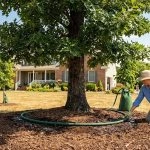
Small and newly planted trees often lean because their roots are not yet strong. Arborists stake them using flexible straps and wooden or metal stakes. Supports are left in place for one growing season, then removed once roots anchor securely.
Corrective Pruning
By trimming back weight on the leaning side, arborists can restore balance and reduce the chance of worsening tilt. Pruning must be done carefully to avoid shock or over-thinning.
Cabling and Bracing
For valuable or mature trees, arborists may install steel cables in the upper branches or braces through weak points in the trunk. These reinforcements reduce strain and extend the life of the tree.
Soil and Root Care
Mulch, aeration, and fertilization improve soil health and root strength. Correcting soil compaction helps roots spread and hold more firmly.
Tree Removal
If a tree poses immediate danger or cannot be stabilized, safe tree removal is the best option. Professionals use ropes, cranes, and protective equipment to bring the tree down without harming property.
Common Mistakes to Avoid
Homeowners sometimes make errors when dealing with leaning trees. These mistakes can increase danger:
- Trying to pull or winch a mature tree upright.
- Ignoring the lean and hoping it improves on its own.
- Over-pruning large sections of the canopy.
- Wrapping chains or wires directly around the bark.
- Attempting removal without the right equipment.
Avoiding these mistakes protects you, your property, and your tree.
Leaning Trees and Safety Precautions
Safety should always come first when a tree begins to lean. Follow these precautions:
- Arrange annual inspections of all mature trees.
- Keep trees pruned to avoid top heaviness.
- Avoid planting large species too close to structures.
- Check your yard after storms for new leans.
- Document problems with photos for insurance or HOA records.
- Only hire licensed and insured tree professionals.
Preventing Trees from Leaning in the First Place
Many leaning trees are the result of avoidable issues. You can reduce risk by following good planting and care practices:
- Choose the right species: Avoid shallow-rooted or fast-growing species near homes. Native oaks, maples, and hickories often provide better long-term stability.
- Plant correctly: Dig a wide hole, set the root flare slightly above soil level, and backfill with native soil rather than rich amendments that encourage shallow rooting.
- Stake only when needed: Young trees benefit from light staking for the first year, but supports should be removed once roots anchor naturally.
- Maintain balanced growth: Prune young trees to promote even branching instead of heavy limbs on one side.
- Protect roots: Avoid trenching, soil compaction, or cutting roots during construction.
- Monitor after storms: Check for soil cracks or small shifts in young trees that can be corrected early.
Preventive care ensures your trees grow straight, strong, and safe reducing the chance of future leaning or failure.
Frequently Asked Questions About Leaning Trees
Is it normal for a tree to lean?
Yes, some trees naturally grow at an angle toward sunlight or because of uneven surroundings. As long as the lean is gradual, stable, and shows no signs of root lift or trunk cracks, it is usually safe.
Can a leaning tree be saved?
Often yes. Young or moderately leaning trees can sometimes be corrected with staking, pruning, or cabling. However, if roots are failing or the lean is severe, removal may be the safest option.
At what angle is a tree unsafe?
Generally, a lean greater than 15 degrees, especially if it appeared suddenly, is considered hazardous. Combine that with soil cracks or root lift, and the tree should be inspected immediately.
Who is responsible if my neighbor’s leaning tree falls on my property?
In most cases, if the tree was healthy and fell due to natural causes like a storm, your insurance may cover the damage. If the tree was clearly neglected or hazardous, your neighbor may be held liable. Documentation from an arborist is often important.
Should I try to straighten a leaning tree myself?
No. Pulling or winching a mature tree upright can damage roots and make the situation worse. Only young trees should be staked, and even then, it is best done with arborist guidance.
How much does it cost to fix or remove a leaning tree?
Costs vary widely. Inspections may be $100–$250, pruning or cabling $200–$1,000, and full removal $500–$3,000, depending on tree size, hazards, and equipment required.
Final Takeaway: Don’t Wait on a Leaning Tree
A leaning tree is not a problem to ignore. While some tilts are harmless, many signal hidden risks that can lead to costly property damage or sudden collapse. Acting early gives you the best chance to save the tree or remove it safely before disaster strikes.
The safest step is to call a qualified arborist for an inspection. With professional guidance, you will know whether your tree can be stabilized with pruning, cabling, or staking or if removal is the only safe option.
For expert leaning tree inspections and safe removal in Southern Maryland, contact Empire Tree Services. Protect your home, your family, and your property with trusted local professionals.