
February 13, 2026
That massive oak dropped a limb on your fence during last week’s storm. You’re ready to grab a chainsaw, but before you do, it’s smart to check the local rules. In Southern Maryland, even basic tree trimming can fall under state or county regulations. A quick check now could save you a fine later.
Whether you live in Mechanicsville, Leonardtown, Prince Frederick, La Plata, Lusby, Waldorf, or Solomons, this guide walks you through the tree trimming and removal laws in Calvert, St. Mary’s, and Charles Counties. You’ll learn when you need a permit, what zones are protected, and how to handle your trees the legal way, without headaches, delays, or surprises.
Why Tree Regulations Exist in Southern Maryland
Tree regulations across Southern Maryland protect both homeowners and the environment. These laws exist to:
- Prevent erosion and sediment runoff into the Chesapeake Bay.
- Preserve wetlands, streams, and tidal buffers that sustain local ecosystems.
- Maintain safety around roads, driveways, and utilities.
- Conserve native tree cover and wildlife habitats.
- Protect property owners from costly violations.
When trees are removed or trimmed incorrectly, runoff increases, soil weakens, and local habitats degrade. Following county regulations keeps your property safe while helping to protect the Bay.
Understanding Maryland’s Statewide Tree Laws
Before diving into local rules, it’s important to understand the laws that apply statewide.
Maryland Roadside Tree Law
The Maryland Roadside Tree Law, listed in Natural Resources Article §5-406, applies to all trees growing within a public road right-of-way. You cannot trim or remove a roadside tree without a permit from the Maryland Department of Natural Resources (MNR). Even cutting branches that extend into a public street or sidewalk could require approval.
Violations may result in fines up to $2,000 for a first offense and $5,000 for repeat violations. When in doubt, contact DNR or your county’s public works department before doing any roadside tree work.
The Chesapeake Bay Critical Area Law
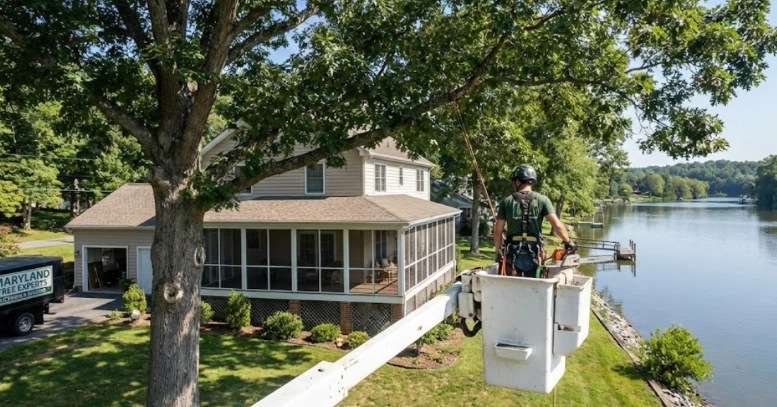
Many properties in Southern Maryland fall within the Chesapeake Bay Critical Area, which includes land up to 1,000 feet inland from tidal waters or wetlands. Within the 100-foot buffer closest to the water, trimming or removing trees requires county approval. Light pruning, such as reducing no more than 25 percent of a tree’s canopy, is generally allowed. Full removal requires a permit and may involve replacement planting.
You can verify whether your property lies in the Critical Area by checking your county’s Planning and Zoning Department maps or contacting their office directly.
The Chesapeake Bay Critical Area: Key Details
The Critical Area Law protects Maryland’s most sensitive shoreline ecosystems. Land within 1,000 feet of tidal water or wetlands is regulated, and the 100-foot buffer along shorelines has the strictest restrictions.
If you plan to remove vegetation or trees within this buffer, a Buffer Management Plan may be required. This plan outlines how you will minimize disturbance, replace lost trees, and control erosion. Even dead or damaged trees must be reported to the county before removal to avoid fines.
Calvert County Tree Regulations
Calvert County’s steep slopes and extensive waterfronts require strict vegetation management. The goal is to reduce runoff into the Bay and preserve shoreline stability.
When Permits Are Required
A Non-Critical Area Vegetation Removal Permit is required if you:
- Remove trees with stumps.
- Cut more than 20 trees at once.
- Disturb more than 5,000 square feet of soil.
- Move more than 100 cubic yards of earth.
Smaller trimming or pruning jobs typically do not require a permit.
Tree Work in the Critical Area
If your property lies in the Critical Area, you must apply for a Critical Area Vegetation Removal Permit before trimming or removing trees. Properties near the Chesapeake Bay, the Patuxent River, or tidal wetlands may also need a Buffer Management Plan. To apply, submit:
- Proof of ownership.
- Photographs of the trees involved.
- A site map marking tree locations.
Permits are typically processed within two to three weeks. Emergency requests for hazardous trees can be expedited.
Real Example: Waterfront Property in Lusby
A Lusby homeowner trimmed several shoreline pines without checking county maps. The property was in the Critical Area, and the county required replanting twice as many native trees and issued a $1,000 fine. A quick phone call to Planning and Zoning could have avoided the problem entirely.
St. Mary’s County Tree Regulations
St. Mary’s County includes farmland, residential neighborhoods, and waterfront areas. Tree work rules depend on proximity to public roads and waterways.
Trees Along County Roads
Trees along county-maintained roads are overseen by the Department of Public Works and Transportation. Homeowners must obtain permission before trimming or removing them. If a storm leaves a hazardous tree leaning toward a road, it may be removed immediately, but documentation and photos must be provided afterward.
Private Property Rules
Homeowners outside the Critical Area can usually prune or remove storm-damaged trees without a permit. Trees near waterways, however, fall under the Critical Area Law and require county approval. The Land Use and Growth Management Office typically processes tree removal permits within 10 to 14 business days.
Real Example: Leonardtown Homeowner
After a severe thunderstorm, a Leonardtown homeowner needed to remove a large oak beside a creek. Because the property was in the Critical Area, they contacted the county first. The county approved the removal and required two replacement plantings, which the homeowner completed within a week without fines or delays.
Charles County Tree Regulations
Charles County enforces forest conservation and shoreline protection laws to safeguard its riverfront communities.
When Permits Are Required
Any property within 1,000 feet of tidal water or wetlands requires county approval before removing large trees or reducing canopy size. Removed trees are often replaced on a one-to-one or two-to-one ratio based on environmental impact.
Licensed Professional Requirement
Tree removal or trimming for compensation must be done by a Maryland Licensed Tree Expert (LTE). Licensed professionals ensure work meets county safety and environmental standards. Permits generally take about two weeks for residential projects, while emergency approvals can be faster.
Real Example: La Plata Property Owner
A La Plata homeowner hired a professional arborist to remove a damaged oak near a drainage ditch. Because they followed proper permitting procedures, the county approved the project without penalty. Hiring a professional and following local guidelines saved time and avoided costly replanting requirements.
Storm Damage and Emergency Tree Removal
Southern Maryland experiences hurricanes, nor’easters, and high winds that can damage or uproot trees. In emergency cases, counties allow immediate removal of hazardous trees that pose safety risks. Homeowners should:
- Take before and after photos.
- Notify the county as soon as possible.
- Hire licensed professionals for large or high-risk removals.
- Keep documentation for insurance or county verification.
If trees are near power lines, coordinate with your utility provider. Never attempt to cut or remove trees in contact with electrical lines.
Beyond emergency removal, understanding insurance coverage, disposal options, and utility coordination completes your tree work preparation.
Insurance, Stump Removal, and Utilities
- Insurance: Most homeowner policies cover storm-related tree damage. Document all work with photos and receipts.
- Stump removal: In most counties, stump grinding does not need a separate permit, but should be noted in your project plan.
- Utilities: Contact the utility provider if trees interfere with power lines. Do not attempt this work yourself.
How to Determine if You Need a Permit
Before starting tree work, ask these questions:
- Is the property within 1,000 feet of tidal water or wetlands?
- Is the tree along a public road or right-of-way?
- Are multiple trees being removed or soil disturbed?
- Is the project part of construction or land grading?
If you answered yes to any of these, consult your county’s Planning and Zoning Department before proceeding.
Frequently Asked Questions
Can I trim trees without a permit?
Yes, small trimming on private property outside the Critical Area is usually allowed. Always confirm with your county before major pruning or removal. Homeowners often trim trees for safety clearance, to improve sunlight exposure, or to reduce the risk of falling limbs during storms. For example, if your trees hang over your driveway or utility lines, consult your local department to determine if the tree extends into a regulated right-of-way. The county may provide guidance or an inspection before you begin work.
Do I need a permit for hazardous or fallen trees?
No permit is required for emergencies involving fallen or hazardous trees that threaten life or property. However, you must document the damage and notify the county within 48 hours. Take multiple photographs before, during, and after removal to show the hazard. Counties often request this documentation for recordkeeping or insurance purposes. If the fallen tree lies partially on a neighbor’s property or across a roadway, coordinate with local authorities to ensure safe cleanup. Always hire a licensed tree professional for complex or large tree removals.
What are the penalties for cutting trees without permission?
Fines for unpermitted tree removal range from $500 to $2,000 per incident, depending on severity and location. Property owners may also be required to replant two to three native trees for every one removed without authorization. Additional penalties can include mandatory inspections, loss of future permit privileges, and property record notations. These measures are designed to preserve local canopy cover and discourage unapproved clearing in regulated zones.
How do I know if my home is in the Critical Area?
Use your county’s online mapping tools or call the Planning and Zoning Department for verification. Provide your property address or parcel ID to confirm your location relative to the Chesapeake Bay and its tributaries. If your land borders creeks, wetlands, or waterfront slopes, it likely falls within the Critical Area boundary. Counties such as Calvert, St. Mary’s, and Charles provide interactive GIS maps where you can zoom in to identify your property’s environmental overlay.
How much do permits cost?
Residential tree removal permits generally cost between $50 and $200 based on project scope and environmental impact. Critical Area permits may involve additional fees for site inspections or Buffer Management Plan reviews. Emergency permits for hazardous trees are often processed faster and may be issued without charge. Permit fees help fund replanting programs, erosion control, and staff oversight for local environmental initiatives.
When is the best time for tree trimming?
Winter and early spring are ideal because trees are dormant and less susceptible to disease. This period allows arborists to shape and thin the canopy before new growth begins. Avoid heavy trimming in late spring or summer during nesting and breeding seasons for local bird species. Fall is also an acceptable time for deadwood removal and hazard inspections. Scheduling professional maintenance every few years helps keep your trees healthy and compliant.
Who can help with tree permits?
Empire Tree Services assists homeowners throughout Southern Maryland with permit applications, documentation, and compliance. Our experienced team handles every step of the process, including contacting county departments, preparing required plans, and submitting paperwork for approval. We guide property owners through storm damage assessments, Critical Area reviews, and ongoing maintenance plans to ensure full compliance and peace of mind.
Get Expert Help Before You Start
Tree regulations in Southern Maryland can seem complex, but compliance is easy with the right team. Before starting any trimming or removal project, contact Empire Tree Services. Our licensed and insured team specializes in tree care, emergency removal, and permit navigation for Calvert, St. Mary’s, and Charles Counties. We handle the paperwork so you don’t have to.
Call (240) 249-7773 or visit localtreeman.com to schedule your free consultation. Our experts will help you complete your project safely, efficiently, and legally.